Risk Assessment: The Senior Officer’s Decision
The Examiner’s Perspective
Examiners are tired of candidates treating Risk Assessment as a "paper exercise" or a box-ticking activity. In a management-level oral exam, the examiner wants to know: "When do you say NO?"
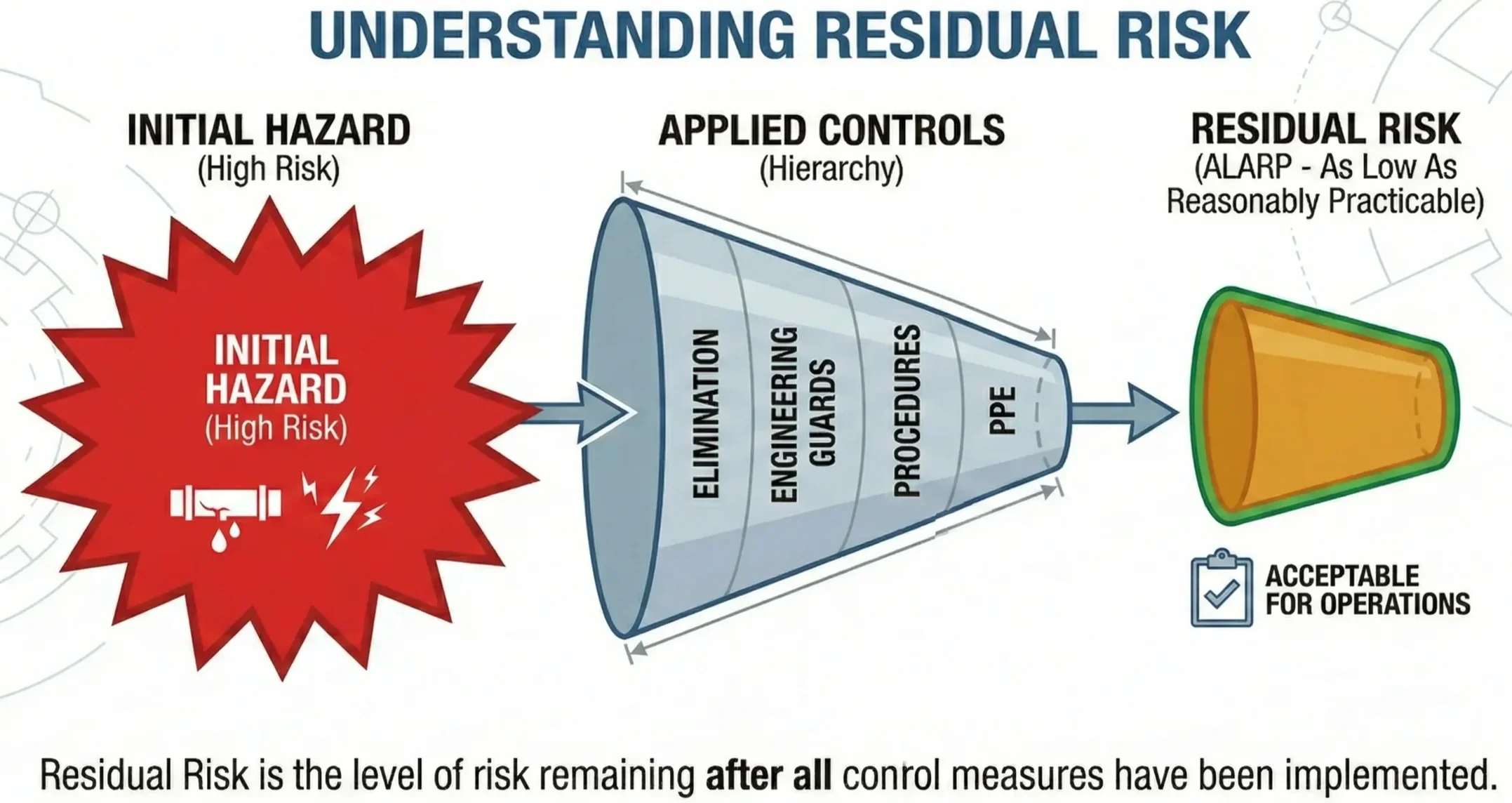
You must demonstrate that you understand the difference between Identifying a hazard and Managing the risk. The critical failure point is often the concept of Residual Risk—the risk that remains after you have applied your safeguards.
Salient Points for a Management Level Answer:
Hazard vs. Risk (The Definition Trap):
Be precise. A Hazard is a source of potential harm (e.g., "Electricity").
A Risk is the likelihood of that harm occurring combined with the severity of the outcome (e.g., "High likelihood of electrocution leading to death").
Examiner’s Check: If you use these terms interchangeably, you will be corrected immediately.
The Hierarchy of Controls (ERIC PD):
When explaining how you reduce risk, do not jump straight to PPE. PPE is the last line of defence.
Demonstrate the correct order:
Eliminate the hazard (Stop the job/remove the danger).
Reduce/Substitute (Use a safer chemical/tool).
Isolate/Engineering Controls (Guards, insulation, ventilation).
Control/Administrative (Permits, LOTO, training).
PPE (Goggles, gloves).
Discipline (Adherence to the procedure).
Tutor Tip: The "PPE Trap" is a classic fail. If an examiner asks how to make a task safe and your first word is "gloves," you are thinking like a rating, not an officer. Always verbalize the thought process: "Can I remove the hazard first?" Then work your way down to PPE.
Residual Risk & ALARP:
This is the core of the competency. After applying controls, you are left with Residual Risk.
The Decision: Your job is to judge if this residual risk is ALARP (As Low As Reasonably Practicable).
The Failure Scenario: If the residual risk is still "High" or "Intolerable," and you sign the permit anyway thinking "we will just be careful," you fail. You must state: "If the Residual Risk is not ALARP, the work does not proceed. We pause and apply more controls."
Tutor Tip: Can you explain "Dynamic Risk Assessment"? It’s not just a buzzword. It’s the '10-minute pause' you take when the weather changes or the tool breaks. We teach you how to articulate this 'Stop Work Authority' to an examiner so it sounds like leadership, not hesitation.
Summary Risk never reaches zero. As a Management Level Officer, you are a Risk Manager. You do not simply sign the form; you validate the controls. If you cannot explain the Hierarchy of Controls or you are hesitant to stop a job due to perceived commercial pressure, you are not ready for the Certificate of Competency. The Risk Assessment is your license to work—but only if the Residual Risk is acceptable.
Relevant Regulations:
ISM Code Section 1.2.2.2: Mandates that the Safety Management System (SMS) should ensure that all risks to its ships, personnel and the environment are assessed and appropriate safeguards are established.
COSWP (Code of Safe Working Practices for Merchant Seafarers) Chapter 1: Managing Occupational Health and Safety.